
AI Present & Future
How Much Water Does AI Use? Inside the Hidden Footprint of AI Data Centers
While public debate focuses on electricity grids and semiconductor supply, artificial intelligence is quietly creating an unprecedented demand for freshwater across local watersheds.
Nazmul Islam · Nov 19, 2026
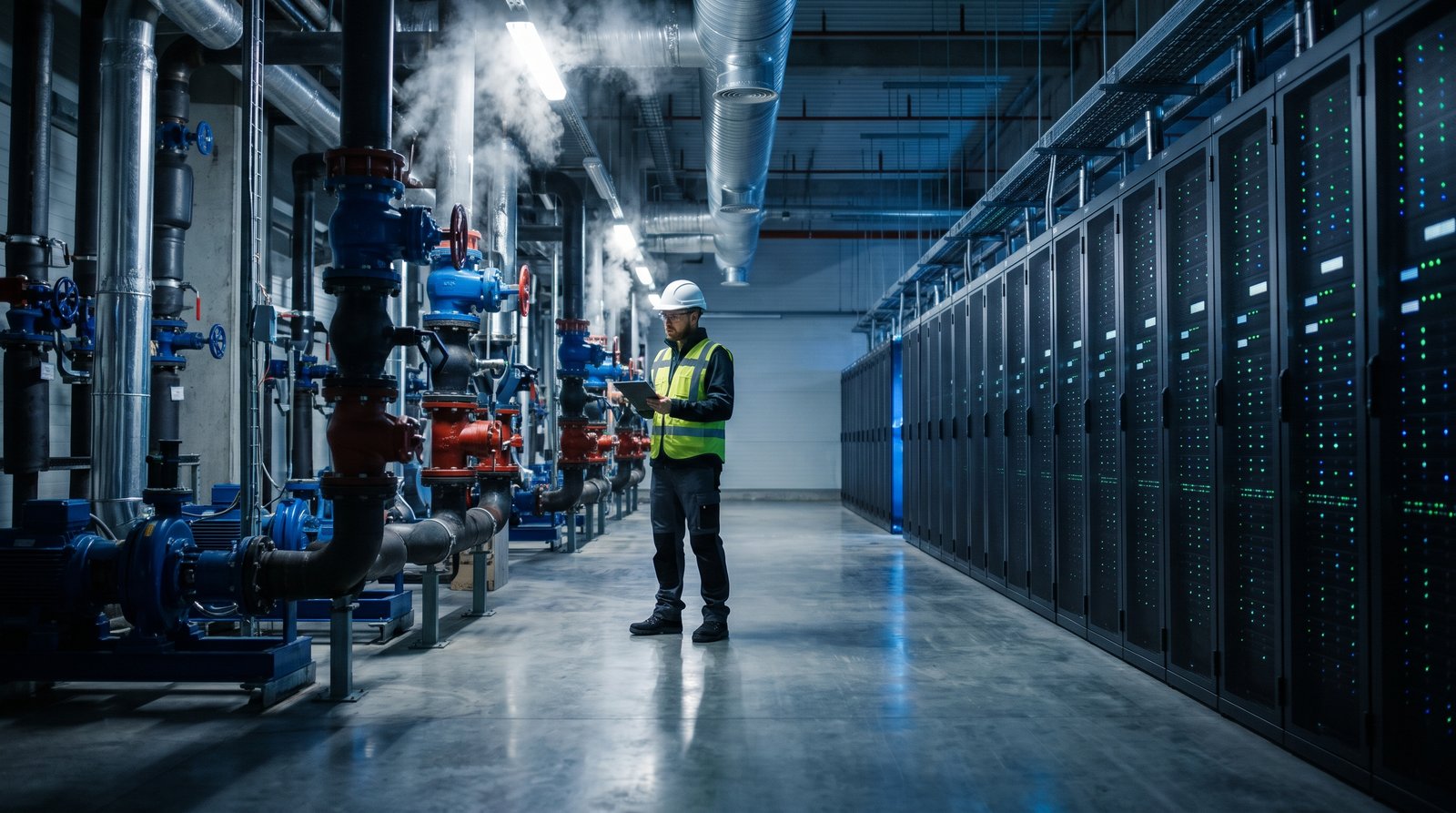
When you type a prompt into a generative artificial intelligence model, the response feels weightlessâÂÂpure software moving across fiber-optic cables. In reality, that single interaction triggers thousands of high-density graphics processing units (GPUs) packed inside massive warehouse-scale facilities. Those chips generate extreme thermal heat, and keeping them from melting requires a continuous, physical resource that rarely makes tech headlines: clean freshwater.
As hyperscale technology companies race to build gigawatt-scale computing campuses, environmental researchers and energy agencies are warning that water scarcityâÂÂnot just electricity capacityâÂÂcould become the defining physical bottleneck of the AI era.
Why Artificial Intelligence Requires So Much Water
A data center consumes water through two distinct channels: direct on-site cooling and indirect off-site electricity generation (Li et al., 2023). Unlike traditional cloud servers that handle lightweight web traffic, AI training and inference clusters operate at dramatically higher power densities, pushing conventional air-cooling systems past their thermal limits.
- Evaporative Cooling Towers (Scope 1 Water): Most large-scale data centers rely on evaporative cooling to reject heat efficiently. Chilled water absorbs heat from server halls and is pumped to rooftop cooling towers, where a significant portion evaporates into the atmosphere. Because evaporation concentrates minerals and dust in the remaining water, facilities must continuously draw fresh potable water to prevent pipe corrosion and bacterial growth (GDSA, 2025).
- Thermoelectric Power Generation (Scope 2 Water): AI servers require vast amounts of electricity. According to the International Energy Agency, global data center electricity demand is projected to climb from roughly 415 terawatt-hours (TWh) in 2024 toward 945 TWh by 2030 (IEA, 2026). Generating that electricity via coal, natural gas, or nuclear steam turbines requires billions of additional liters of cooling water at power plants.
- Semiconductor Manufacturing (Scope 3 Water): Fabricating advanced AI processors requires ultra-pure water (UPW) to rinse silicon wafers between microscopic etching stepsâÂÂmeaning water is embedded in AI hardware before a single server is ever switched on.
By the Numbers: The Scale of AI Water Consumption
Peer-reviewed research into AI infrastructure has revealed how rapidly compute scaling translates into physical water withdrawal. In a landmark study analyzing the water footprint of large language models, researchers estimated that training GPT-3 in Microsoft's U.S. data centers evaporated approximately 700,000 liters of clean freshwater (Li et al., 2023). More broadly, the same research projects that global AI demand could drive 4.2 billion to 6.6 billion cubic meters of water withdrawal annually by 2027âÂÂexceeding the total annual water withdrawal of several European nations (Li et al., 2023).
The Regional Bottleneck: Building in Water-Stressed Basins
The core challenge of AI water consumption is geographic concentration. Data center developers choose locations based on cheap land, fiber connectivity, and tax incentivesâÂÂoften placing facilities in drought-prone regions such as Phoenix, Arizona, parts of Texas, or southern Europe. Analysis cited by the UK Government Digital Sustainability Alliance notes that roughly 55% of global data centers sit in river basins facing high water pollution or scarcity risks (GDSA, 2025).
When a single hyperscale campus draws millions of gallons per day during peak summer heatwavesâÂÂprecisely when evaporative cooling is least efficientâÂÂit competes directly with municipal drinking water supplies and agricultural irrigation.
Can Next-Generation Cooling Solve AI's Thirst?
To prevent regulatory pushback and community moratoriums, infrastructure operators are shifting away from open-loop evaporative cooling toward closed-loop engineering:
- Direct-to-Chip Liquid Cooling: Cold plates circulate dielectric fluid or treated water directly over high-wattage GPUs in a sealed loop, capturing up to 70% to 80% of server heat without evaporating water into the air.
- Reclaimed and Non-Potable Water: Several major cloud operators now partner with municipal wastewater treatment plants to use recycled industrial greywater rather than potable drinking water.
- Water-Aware Workload Scheduling: Researchers have demonstrated that shifting flexible AI training runs to cooler nighttime hours or water-abundant regions can cut direct cooling evaporation by double-digit percentages (Li et al., 2023).
Frequently Asked Questions (FAQ)
How much water does a single ChatGPT or AI prompt use?
Depending on the data center's location, season, and cooling efficiency, a typical session of 10 to 50 conversational AI queries consumes roughly 500 milliliters (about one standard water bottle) of freshwater through direct cooling and power generation (Li et al., 2023). Complex image, video, or deep reasoning tasks require substantially more compute and water.
Why don't data centers use seawater or salt water for cooling?
Salt water is highly corrosive to metal heat exchangers, pumps, and cooling tower components, and its mineral content causes rapid scaling. Desalinating seawater on-site requires massive amounts of additional electricity, making it economically and energetically impractical for most inland facilities.
Are governments regulating AI data center water usage?
Yes. Under the European Union's updated Energy Efficiency Directive, large data center operators are now legally required to monitor and publicly report annual water consumption and sustainability metrics (GDSA, 2025), while several U.S. municipalities have introduced stricter water-permitting reviews for new hyperscale projects.
Sources & Research References
- International Energy Agency (IEA). Key Questions on Energy and AI / Energy and AI Report (2025âÂÂ2026). https://www.iea.org/energy-system/buildings/data-centres-and-data-transmission-networks
- Li, P., Yang, J., Islam, M. A., & Ren, S. Making AI Less "Thirsty": Uncovering and Addressing the Secret Water Footprint of AI Models. University of California, Riverside / arXiv:2304.03271. https://arxiv.org/abs/2304.03271
- UK Government Digital Sustainability Alliance (GDSA) / Sustainable ICT. AI's Thirst for Water (September 2025). https://sustainableict.blog.gov.uk/2025/09/17/ais-thirst-for-water/
- Corporate Environmental Sustainability Reports (Google 2024 Environmental Report, Microsoft FY24 Environmental Sustainability Report, Meta 2024 Sustainability Report).Â